When one room stays chilly even though the thermostat is up, trapped air in the heating loop is often the reason. If you’re trying to figure out how to bleed baseboard heat, the good news is that the fix can be straightforward in some homes. The key is knowing what kind of system you have, where the air is actually trapped, and when a simple bleed is not enough.
Baseboard heat works by sending hot water from the boiler through piping and fin-tube baseboard units around the house. When air gets into that closed loop, water flow can slow down or stop in part of the system. That is when homeowners notice baseboards that are warm on one end and cold on the other, rooms that never seem to catch up, or gurgling and rushing-water sounds inside the pipes.
In Massachusetts, this tends to show up right when you need dependable heat the most. A heating system that is only half-working can feel like a small issue at first, but air in the lines can also point to pressure problems, leaks, or failing components. That is why it helps to treat bleeding baseboard heat as both a quick troubleshooting step and a chance to spot larger boiler issues early.
How to bleed baseboard heat safely
Before you do anything, make sure you are dealing with a hot-water baseboard system, not electric baseboard heat. Electric baseboard units do not have water in them, so there is nothing to bleed. If your home has a boiler, pipes, and fin-tube baseboards, you likely have hydronic baseboard heat.
Next, lower the thermostat so the system is not actively calling for heat while you get set up. You do not want the circulator running hard while you are trying to release air. Give the system a few minutes to settle, and be careful around any piping or boiler components that may still be hot.
Some baseboard systems have manual bleeder valves on the baseboard itself or at high points in the piping. Others do not. In many homes, bleeding is done at the boiler through purge valves rather than at each baseboard unit. That difference matters. If you start opening valves without understanding the layout, you can make a mess, drop system pressure, or fail to remove the air where it is actually trapped.
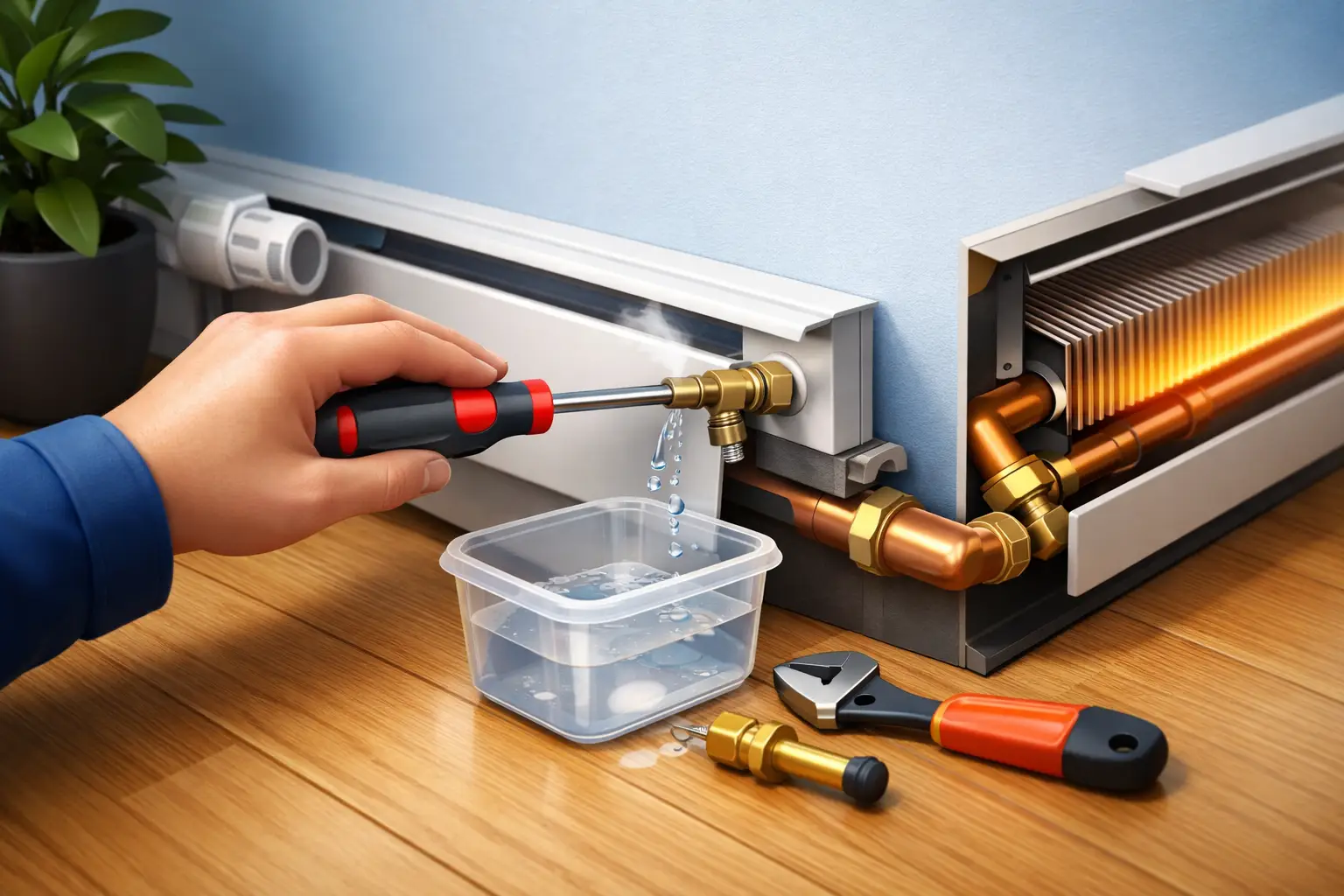
If you do have manual bleeder valves, place a cup or rag under the valve and use the proper key or screwdriver, depending on the style. Open it slowly, just enough to let air hiss out. Once you get a steady stream of water with no sputtering, close the valve snugly. Do not overtighten it.
Move carefully from one affected zone or unit to the next if your setup allows for that. In a simple one-zone system, that may be all you need. In a multi-zone system, especially one with zone valves and purge stations near the boiler, the proper process is usually more controlled than just opening baseboard vents one by one.
What to watch while bleeding
The biggest thing to monitor is boiler pressure. Most residential hot-water boiler systems need enough pressure to push water to the highest point in the house. If pressure drops too low while you are bleeding air, you can end up pulling in more air or leaving upper floors without circulation.
A typical cold-fill pressure is often around 12 to 15 psi in a two-story home, but it depends on the height and layout of the system. If the gauge is already reading low before you start, bleeding the system may not solve the problem by itself. You could be dealing with a faulty pressure-reducing valve, an expansion tank issue, or a small leak somewhere in the piping.
It also matters what comes out of the valve. A quick burst of air followed by steady water is normal. Dirty water, weak sputtering that never clears, or no water at all suggests there may be a circulation or fill problem. If you keep opening bleeders and only get air, stop and reassess. That usually means the system is not maintaining proper water pressure.
When baseboard heat needs purging, not just bleeding
This is where many homeowners get stuck. They search for how to bleed baseboard heat, but their system really needs a zone purge at the boiler. That is common when a zone is completely cold, after recent boiler work, after a leak repair, or when the system has taken on a lot of air.
Purging usually involves isolating one zone at a time, using shutoff valves and a drain valve near the boiler, and forcing fresh water through the loop until all the air is pushed out. It is more effective than opening a small bleeder at the end of a baseboard run because it moves a stronger volume of water through the full circuit.
The trade-off is that purging is more technical. You need to understand which valves to close, which to open, and how to avoid overfilling or stressing older components. On some systems, the setup is clear and accessible. On others, especially in older homes around Hudson and surrounding communities, the boiler piping has been modified over the years and is not always homeowner-friendly.
Signs the problem is bigger than trapped air
Air does not always show up on its own. If you find yourself bleeding the same zone repeatedly, there is usually another cause behind it. A closed heating system should not need constant air removal.
One common issue is a small leak. It may be obvious, like water under the boiler, or subtle, like a damp fitting that evaporates before you notice it. Another possibility is an expansion tank that has lost its charge. When that happens, pressure swings can become more severe, which can pull air into the system or trigger relief valve discharge.
A failing automatic air vent near the boiler can also play a role. So can circulator problems, especially if the pump is running but not moving water effectively through a zone. In some cases, the baseboard itself is not the problem at all. A stuck zone valve, clogged line, or boiler control issue may be what is leaving one part of the house cold.
If you hear banging, frequent gurgling, or notice pressure changes every time the boiler runs, those are worth taking seriously. A system that is noisy and uneven today can turn into a no-heat call during the next cold snap.
A few practical tips before you start
Have towels ready and wear gloves if you are working near hot piping. Use a small container so you can catch water without soaking flooring or trim. If your bleeder valve looks corroded or feels fragile, do not force it. Replacing a snapped bleeder or leaking vent is a bigger repair than most homeowners want to create on purpose.
It also helps to think about timing. If the system has been cold for hours, the pressure reading may be different than when it is fully hot. If you have recently added water to the boiler, give it a little time to stabilize. Quick adjustments often lead to confusion because you are reading the system before it settles.
And if your home has an older boiler, do not assume every valve should be touched. Some older shutoffs and drains do not reseal cleanly once disturbed. That does not mean the system cannot be serviced. It just means careful handling matters.
When to call for service
If you cannot find bleeder valves, if pressure drops too low, if one zone stays cold after bleeding, or if the system keeps pulling in air, it is time for a professional diagnosis. The same goes for any active leak, relief valve discharge, or boiler that is short cycling or making unusual noise.
For many homeowners, the safest approach is to handle the obvious simple step and call when the signs point beyond that. There is no downside to being cautious with a boiler system. Good heat depends on proper pressure, clean circulation, functioning controls, and safe operation as a whole.
At Mass Plumbing & Heating, we see this often in homes where one room never heats evenly or where a recent repair introduced air into the system. Sometimes the answer is a quick purge and pressure check. Sometimes it leads to catching a failing component before it causes a complete no-heat situation.
If you are learning how to bleed baseboard heat, think of it as a first response, not a cure-all. When the system responds well, great. When it does not, that is useful information too. A quiet, evenly heated home is usually the result of a boiler system that is balanced, pressurized correctly, and serviced before small warning signs turn into winter emergencies.
Leave a Reply