When your heating system starts struggling in the middle of a Massachusetts winter, the question stops being abstract very quickly. For many homeowners, boiler vs furnace home heating comes down to one practical decision: what will keep the house comfortable, run efficiently, and make sense for the way the home is built?
The right answer depends on more than fuel type or sticker price. Boilers and furnaces heat homes in very different ways, and those differences affect comfort, operating cost, maintenance, installation work, and long-term value. If you are planning a replacement or thinking about an upgrade, it helps to understand how each system actually performs in a real home.
Boiler vs Furnace Home Heating: The Core Difference
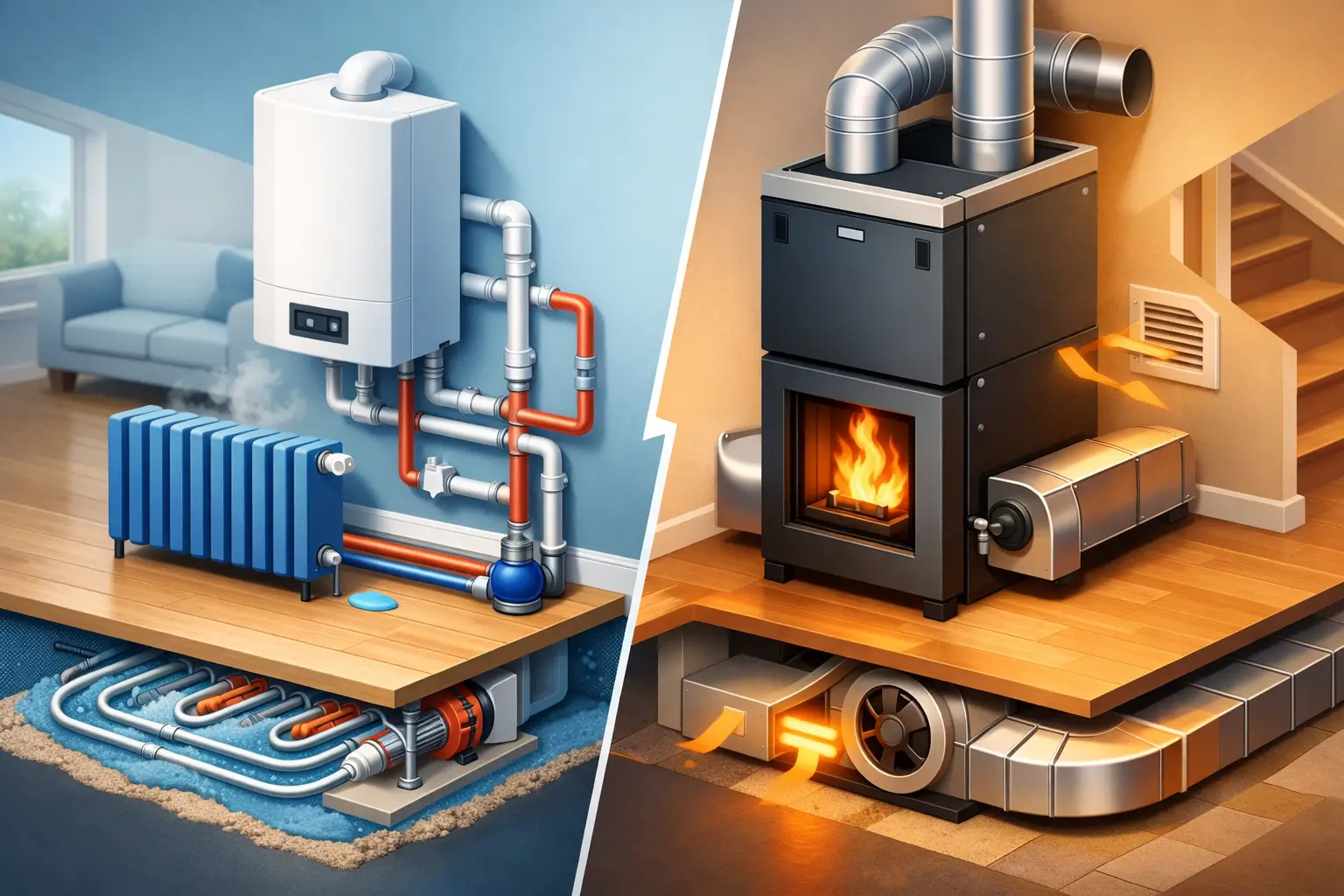
A boiler heats water and sends that heat through baseboard units, radiators, radiant floor tubing, or steam piping, depending on the system. A furnace heats air and pushes that warm air through ductwork to vents around the house.
That basic difference matters because water and air carry heat differently. Hot water systems usually deliver steadier, more even warmth. Forced-air systems tend to heat rooms faster, but they can also create more temperature swings as the system cycles on and off.
If you have an older New England home with baseboard heat or radiators, a boiler often fits the structure naturally. If your home already has ductwork for central air, a furnace may be the simpler and more cost-effective path.
How Boilers Feel in Daily Use
Many homeowners describe boiler heat as quieter and more comfortable. That is because the system radiates or convects heat gently instead of blowing warm air into a room. Baseboards and radiant floors can create a very consistent indoor temperature, especially during long cold stretches.
Boilers also do not move dust and allergens through ductwork the way a furnace can. For some households, that is a meaningful comfort benefit. If anyone in the home is sensitive to dry air or airborne dust, hydronic heat may feel noticeably better.
That said, boilers are not always quick to respond. If you turn the thermostat up several degrees, the warm-up can feel gradual. That slower response is not a flaw in every situation, but it is a trade-off. People who want fast temperature changes often prefer the responsiveness of a furnace.
How Furnaces Feel in Daily Use
A furnace can raise room temperature quickly, which is one reason so many homeowners like forced-air systems. When the thermostat calls for heat, warm air moves through the house fast. In a home with good duct design, that can make the whole system feel very responsive.
A furnace also gives you one major convenience a boiler does not: it can share ductwork with central air conditioning. If you need both heating and cooling, that combination can simplify installation and equipment planning.
The downside is that forced air can feel less even from room to room. Some homes develop hot and cold spots, especially if ducts are undersized, leaky, or poorly balanced. Furnaces can also be noisier than boilers because you hear the blower start, air moving through vents, and the system cycling more noticeably.
Which System Is More Efficient?
Efficiency depends on the age of the equipment, the fuel being used, and how well the system matches the home. A newer high-efficiency boiler can perform extremely well, especially in homes designed around hydronic heat. The same is true for a high-efficiency furnace in a house with properly sized, sealed ductwork.
On paper, one system does not automatically beat the other in every house. In practice, distribution losses make a difference. Boilers do not lose heat through duct leaks because they use piping, while furnaces can lose efficiency if warm air escapes through gaps in ducts running through attics, basements, or unconditioned spaces.
But that does not mean a boiler is always cheaper to run. If an older boiler is oversized or poorly maintained, or if a steam system is out of balance, efficiency can suffer. A modern condensing furnace may outperform an outdated boiler by a wide margin. The real comparison should be between the systems available for your home, not between two generic categories.
Installation Cost and Replacement Complexity
For many homeowners, this is where the decision gets real. Replacing a boiler with another boiler is often straightforward if the piping network is in good condition and the existing heat emitters still make sense. Replacing a furnace with a new furnace is also usually more direct when the duct system is sound.
Switching from one type to the other is a different conversation. Converting a home from boiler heat to furnace heat means adding ductwork, which can be a major project in an older house. Going from furnace to boiler usually means installing piping, heat emitters, and often rethinking how cooling will be handled.
That is why the existing home setup matters so much. In many cases, the most cost-effective choice is the one that works with what the house already has. Not always, but often.
Maintenance and Repairs
Both systems need regular service. A boiler should be inspected and maintained to keep burners, controls, pumps, expansion components, and safety devices working properly. A furnace needs attention to burners, heat exchangers, blower components, filters, controls, and venting.
Boilers tend to have fewer moving air-handling parts, but they are not maintenance-free. Air in the lines, circulation issues, pressure problems, or aging zone controls can affect performance. Steam systems have their own service needs and require technicians who understand them well.
Furnaces need filter changes on schedule, and ductwork should not be ignored. A good furnace can operate very reliably, but airflow restrictions, dirty components, or ignition issues can reduce efficiency and comfort. In either case, annual maintenance is usually far less expensive than an emergency repair call during a cold snap.
Comfort, Noise, and Air Quality
This is where homeowner preference matters a lot. If your priority is gentle, even heat and quiet operation, a boiler often has the edge. Radiant and baseboard systems are especially appealing in homes where comfort matters more than rapid temperature changes.
If your priority is quicker heating and combined heating and cooling through one distribution system, a furnace makes sense. Many families like the convenience of a single ducted setup, especially in homes already built for it.
Air quality can tilt the decision too. Furnaces can support filtration and whole-home humidity equipment, which is a benefit. At the same time, ducted air movement can circulate dust if the system is dirty or poorly maintained. Boilers avoid that issue because they do not rely on blowing air through the home.
What Works Best in Massachusetts Homes?
In Hudson and surrounding communities, we see both systems for good reason. Many older homes were built around boilers, baseboard heat, radiators, or steam. Those homes often perform very well with an updated boiler, especially when the existing distribution system is still in good shape.
Homes with central ductwork, especially newer homes or homes that already rely on forced air for cooling, often lean toward furnaces because the infrastructure is already there. That can make replacement simpler and less disruptive.
Fuel source matters too. Natural gas availability, oil equipment, and the condition of older systems can all change the recommendation. Sometimes the smartest move is not just choosing between a boiler and furnace, but pairing that choice with a fuel conversion or efficiency upgrade.
Boiler vs Furnace Home Heating: How to Decide
The best way to approach boiler vs furnace home heating is to start with the house, not the equipment brochure. What kind of distribution system is already installed? How old is it? Do you also need air conditioning? Are there comfort complaints in specific rooms? Is energy cost the top concern, or is the bigger goal long-term reliability?
If your home already has hydronic heat and you like the comfort it provides, staying with a boiler is often the right move. If your home has good ductwork and you want one system that works naturally with central AC, a furnace may be the better fit.
There are also cases where a homeowner should look beyond a basic replacement. An oversized system, recurring repair issues, uneven heating, or high fuel bills may point to deeper design problems that should be addressed before new equipment is installed. That is where a careful evaluation matters. A dependable local contractor should look at the home as a whole, not just swap out the old unit and hope for the best.
For homeowners who want clear guidance, the most useful question is not which system wins on paper. It is which system fits your home, your comfort preferences, and your budget with the fewest compromises. That answer is usually simpler once someone has looked at the equipment, the layout, and how the house actually heats through a Massachusetts winter.
Leave a Reply